Gamma regression for blood clotting#
As a preliminary example of this package’s functionality, we provide an example of performing a Gamma regression, which is used when the response variable is continuous and positive. We have adapted the following canonical example of a Gamma regression from McCullagh & Nelder (1989).
Nine different percentage concentrations with prothrombin-free plasma (\(u\)) and clotting was induced via two lots of thromboplastin. Previous researchers had fitted a hyperbolic model, using an inverse transformation of the data for both lots \(1\) and \(2\), but we will analyze both lots using the inverse link and Gamma family.
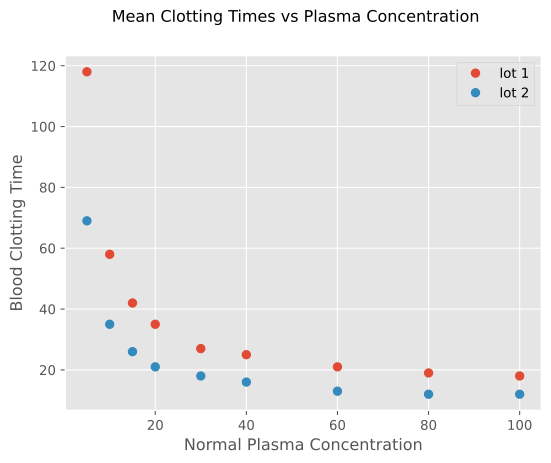
The following initial plots hint at using a log scale for \(u\) to achieve inverse linearity, as well as the fact that the two lots have different regression and intercept coefficients.
[1]:
from scikit_stan import GLM

import numpy as np
import pandas as pd

import matplotlib as mpl
import matplotlib.pyplot as plt
[3]:
# ATTRIBUTION: McCullagh & Nelder (1989), chapter 8.4.2 p 301-302
bcdata_dict = {
    "u": np.array([5, 10, 15, 20, 30, 40, 60, 80, 100]),
    "lot1": np.array([118, 58, 42, 35, 27, 25, 21, 19, 18]),
    "lot2": np.array([69, 35, 26, 21, 18, 16, 13, 12, 12]),
}
bc_data_X = np.log(bcdata_dict["u"])
bc_data_lot1 = bcdata_dict["lot1"]
bc_data_lot2 = bcdata_dict["lot2"]
[4]:
l1, = plt.plot(bcdata_dict["u"], bcdata_dict["lot1"], "o", label="lot 1")
l2, = plt.plot(bcdata_dict["u"], bcdata_dict["lot2"], "o", label="lot 2")

plt.suptitle("Mean Clotting Times vs Plasma Concentration")
plt.xlabel('Normal Plasma Concentration')
plt.ylabel('Blood Clotting Time')

plt.legend(handles=[l1, l2])
/home/docs/checkouts/readthedocs.org/user_builds/scikit-stan/conda/v0.1.0/lib/python3.9/site-packages/traitlets/traitlets.py:3258: FutureWarning: --rc={'figure.dpi': 96} for dict-traits is deprecated in traitlets 5.0. You can pass --rc <key=value> ... multiple times to add items to a dict.
  warn(
[4]:
<matplotlib.legend.Legend at 0x7f866f546f70>
[5]:
l1, = plt.plot(bc_data_X, bc_data_lot1, "o", label="lot 1")
l2, = plt.plot(bc_data_X, bc_data_lot2, "o", label="lot 2")

plt.suptitle("Mean Clotting Times vs Plasma Concentration")
plt.xlabel('Normal Plasma Concentration')
plt.ylabel('Blood Clotting Time')

plt.legend(handles=[l1, l2])
[5]:
<matplotlib.legend.Legend at 0x7f866f4cedf0>
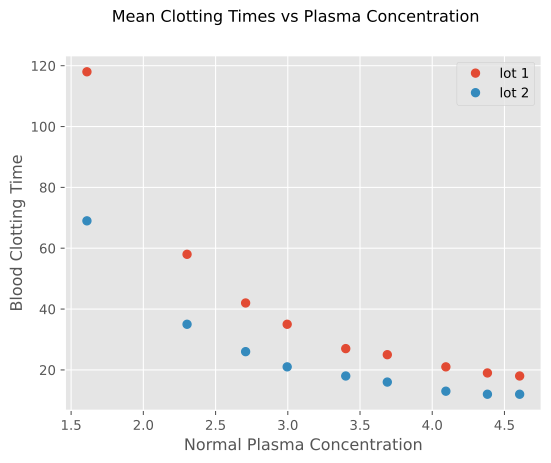
After this preliminary data analysis, we fit two lines to the two lots of data. Using \(x = \log u\), we fit a GLM to the data.
The original results were as follows, and we recreate regression coefficients within a standard deviation of these values:
As in previous work, we will fit two different linear models for each lot in the dataset. As usual, the \(\alpha\) parameter is the regression intercept and \(\mathbf{\beta}\) is vector of regression coefficients and the parameter \(\sigma\) represents an auxiliary variable for the model. In this case, \(\sigma\) is the shape parameter for the Gamma distribution.
[6]:
# Initialize two different GLM objects, one for each lot.
glm_gamma1 = GLM(family="gamma", link="inverse", seed=1234)
glm_gamma2 = GLM(family="gamma", link="inverse", seed=1234)

# Fit the model. Note that default priors are used without autoscaling, see the
# API to see how to change these.
glm_gamma1.fit(bc_data_X, bc_data_lot1, show_console=False)
glm_gamma2.fit(bc_data_X, bc_data_lot2, show_console=False)

print(glm_gamma1.alpha_, glm_gamma1.beta_)
print(glm_gamma2.alpha_, glm_gamma2.beta_)
/home/docs/checkouts/readthedocs.org/user_builds/scikit-stan/checkouts/v0.1.0/scikit_stan/utils/validation.py:229: UserWarning: Passed data is one-dimensional, while estimator expects it to be at at least two-dimensional.
  warnings.warn(
/home/docs/checkouts/readthedocs.org/user_builds/scikit-stan/checkouts/v0.1.0/scikit_stan/generalized_linear_regression/glm.py:498: UserWarning: Prior on intercept not specified. Using default prior.
                alpha ~ normal(mu(y), 2.5 * sd(y)) if Gaussian family else normal(0, 2.5)
  warnings.warn(
/home/docs/checkouts/readthedocs.org/user_builds/scikit-stan/checkouts/v0.1.0/scikit_stan/generalized_linear_regression/glm.py:543: UserWarning: Prior on auxiliary parameter not specified. Using default unscaled prior
                        sigma ~ exponential(1)

  warnings.warn(
20:26:12 - cmdstanpy - INFO - CmdStan start processing
20:26:13 - cmdstanpy - INFO - CmdStan done processing.
20:26:13 - cmdstanpy - WARNING - Some chains may have failed to converge.
        Chain 1 had 20 divergent transitions (2.0%)
        Chain 2 had 39 divergent transitions (3.9%)
        Chain 3 had 26 divergent transitions (2.6%)
        Chain 4 had 34 divergent transitions (3.4%)
        Use function "diagnose()" to see further information.
20:26:13 - cmdstanpy - INFO - CmdStan start processing
20:26:13 - cmdstanpy - INFO - CmdStan done processing.
20:26:13 - cmdstanpy - WARNING - Some chains may have failed to converge.
        Chain 1 had 8 divergent transitions (0.8%)
        Chain 2 had 37 divergent transitions (3.7%)
        Chain 3 had 17 divergent transitions (1.7%)
        Chain 4 had 8 divergent transitions (0.8%)
        Use function "diagnose()" to see further information.
-0.014230614903001692 [0.01500947]
-0.019889316430406125 [0.02298595]
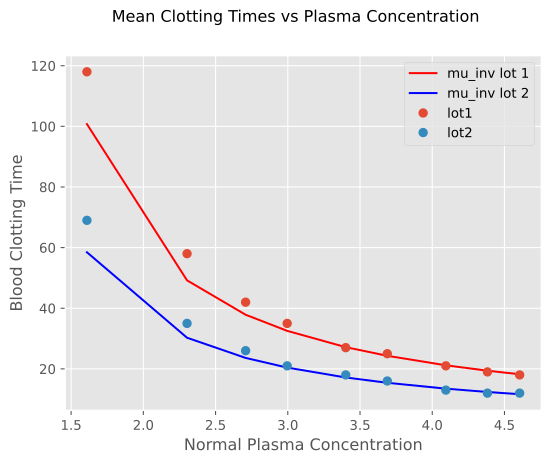
As can be seen above, the fitted model has the following parameters, which are within one standard deviation of the results from past studies.
As a verification of the accuracy of the fitted model, we can plot the fitted lines and the data.
[7]:
mu_inv1 = 1 /( glm_gamma1.alpha_ + glm_gamma1.beta_ * bc_data_X)
mu_inv2 = 1 /( glm_gamma2.alpha_ + glm_gamma2.beta_ * bc_data_X)
[8]:
mlot1, = plt.plot(bc_data_X, mu_inv1, "r", label="mu_inv lot 1")
mlot2, = plt.plot(bc_data_X, mu_inv2, "b", label="mu_inv lot 2")
l1, = plt.plot(bc_data_X, bc_data_lot1, "o", label="lot1")
l2, = plt.plot(bc_data_X, bc_data_lot2, "o", label="lot2")

plt.suptitle("Mean Clotting Times vs Plasma Concentration")
plt.xlabel('Normal Plasma Concentration')
plt.ylabel('Blood Clotting Time')

plt.legend(handles=[mlot1, mlot2, l1, l2])
[8]:
<matplotlib.legend.Legend at 0x7f866dbb8100>
As this package is a wrapper around CmdStanPy, we can gather additional statistics about the fitted model with methods from that package. In particular, we can consider further statistics about the model by using CmdStanPy’s summary method on the results of the fit.
Notice that \(\mu\) (“mu”) and the link-inverted \(\mu\) (“mu unlinked”) are included as part of the model summary.
[9]:
glm_gamma1.fitted_samples_.summary()
[9]:
| Mean | MCSE | StdDev | 5% | 50% | 95% | N_Eff | N_Eff/s | R_hat | |
|---|---|---|---|---|---|---|---|---|---|
| name | |||||||||
| lp__ | -37.778600 | 0.046785 | 1.403670 | -40.522200 | -37.400600 | -36.293900 | 900.1620 | 2557.28000 | 1.00412 |
| alpha | -0.014231 | 0.000337 | 0.010197 | -0.029048 | -0.015165 | 0.003691 | 914.9120 | 2599.18000 | 1.00151 |
| beta[1] | 0.015010 | 0.000148 | 0.004417 | 0.007862 | 0.015049 | 0.022065 | 889.3810 | 2526.65000 | 1.00240 |
| sigma | 4.691710 | 0.053930 | 2.090850 | 1.836280 | 4.359500 | 8.560740 | 1502.9555 | 4269.75993 | 0.99991 |
| mu[1] | 0.009926 | 0.000119 | 0.004447 | 0.003997 | 0.009162 | 0.018356 | 1386.4200 | 3938.70000 | 1.00042 |
| mu[2] | 0.020330 | 0.000080 | 0.003828 | 0.014891 | 0.019936 | 0.027054 | 2308.7500 | 6558.94000 | 1.00129 |
| mu[3] | 0.026416 | 0.000107 | 0.004510 | 0.019901 | 0.026111 | 0.033674 | 1764.6300 | 5013.17000 | 1.00227 |
| mu[4] | 0.030734 | 0.000140 | 0.005317 | 0.022905 | 0.030426 | 0.039585 | 1443.2200 | 4100.07000 | 1.00264 |
| mu[5] | 0.036820 | 0.000193 | 0.006703 | 0.026990 | 0.036428 | 0.048149 | 1208.6500 | 3433.66000 | 1.00285 |
| mu[6] | 0.041138 | 0.000232 | 0.007787 | 0.029577 | 0.040712 | 0.054328 | 1122.6700 | 3189.40000 | 1.00289 |
| mu[7] | 0.047223 | 0.000290 | 0.009395 | 0.033157 | 0.046676 | 0.063299 | 1052.0200 | 2988.70000 | 1.00289 |
| mu[8] | 0.051541 | 0.000331 | 0.010571 | 0.035570 | 0.050966 | 0.069343 | 1020.8900 | 2900.24000 | 1.00288 |
| mu[9] | 0.054891 | 0.000363 | 0.011498 | 0.037506 | 0.054330 | 0.074204 | 1003.0600 | 2849.60000 | 1.00286 |
| mu_unlinked[1] | 124.261000 | 1.504720 | 68.359200 | 54.425400 | 109.158000 | 250.085000 | 2063.8600 | 5863.24000 | 1.00065 |
| mu_unlinked[2] | 50.864500 | 0.167089 | 9.347230 | 36.961500 | 50.161500 | 67.148200 | 3129.4700 | 8890.55000 | 1.00113 |
| mu_unlinked[3] | 38.934400 | 0.135521 | 6.603890 | 29.687800 | 38.303300 | 50.211100 | 2374.5700 | 6745.93000 | 1.00172 |
| mu_unlinked[4] | 33.495100 | 0.134257 | 5.800810 | 25.250000 | 32.875800 | 43.609700 | 1866.8300 | 5303.50000 | 1.00191 |
| mu_unlinked[5] | 28.056300 | 0.133558 | 5.192950 | 20.766700 | 27.453900 | 37.045600 | 1511.7900 | 4294.85000 | 1.00196 |
| mu_unlinked[6] | 25.187500 | 0.132405 | 4.919700 | 18.397700 | 24.564600 | 33.805600 | 1380.6000 | 3922.16000 | 1.00191 |
| mu_unlinked[7] | 22.038500 | 0.129934 | 4.634350 | 15.784500 | 21.424800 | 30.159800 | 1272.1300 | 3614.00000 | 1.00182 |
| mu_unlinked[8] | 20.254300 | 0.127863 | 4.472150 | 14.411100 | 19.620900 | 28.086300 | 1223.3300 | 3475.36000 | 1.00174 |
| mu_unlinked[9] | 19.062300 | 0.126239 | 4.361420 | 13.473300 | 18.406200 | 26.647000 | 1193.6300 | 3391.01000 | 1.00168 |
[10]:
glm_gamma2.fitted_samples_.summary()
[10]:
| Mean | MCSE | StdDev | 5% | 50% | 95% | N_Eff | N_Eff/s | R_hat | |
|---|---|---|---|---|---|---|---|---|---|
| name | |||||||||
| lp__ | -33.593000 | 0.052207 | 1.441860 | -36.442000 | -33.230700 | -32.049700 | 762.7800 | 1745.49000 | 1.00250 |
| alpha | -0.019889 | 0.000554 | 0.016820 | -0.045271 | -0.020698 | 0.009217 | 921.2220 | 2108.06000 | 1.00569 |
| beta[1] | 0.022986 | 0.000231 | 0.007030 | 0.011729 | 0.022965 | 0.034812 | 923.2150 | 2112.62000 | 1.00428 |
| sigma | 4.656330 | 0.059330 | 2.086980 | 1.825410 | 4.360940 | 8.579550 | 1237.3025 | 2831.35585 | 1.00036 |
| mu[1] | 0.017105 | 0.000219 | 0.007794 | 0.006798 | 0.015984 | 0.030622 | 1267.7900 | 2901.12000 | 1.00470 |
| mu[2] | 0.033038 | 0.000143 | 0.006629 | 0.023800 | 0.032344 | 0.044242 | 2137.4100 | 4891.11000 | 1.00120 |
| mu[3] | 0.042358 | 0.000163 | 0.007492 | 0.031572 | 0.041706 | 0.055453 | 2116.3100 | 4842.81000 | 1.00020 |
| mu[4] | 0.048970 | 0.000208 | 0.008639 | 0.036295 | 0.048330 | 0.064112 | 1726.4900 | 3950.79000 | 1.00032 |
| mu[5] | 0.058290 | 0.000287 | 0.010705 | 0.042183 | 0.057501 | 0.077193 | 1396.1200 | 3194.78000 | 1.00088 |
| mu[6] | 0.064903 | 0.000346 | 0.012362 | 0.045948 | 0.063959 | 0.086757 | 1273.8900 | 2915.09000 | 1.00129 |
| mu[7] | 0.074223 | 0.000434 | 0.014852 | 0.051542 | 0.073258 | 0.100046 | 1171.5800 | 2680.95000 | 1.00178 |
| mu[8] | 0.080836 | 0.000497 | 0.016688 | 0.055468 | 0.079888 | 0.109560 | 1126.7500 | 2578.38000 | 1.00206 |
| mu[9] | 0.085965 | 0.000547 | 0.018140 | 0.058355 | 0.085109 | 0.117108 | 1101.1200 | 2519.71000 | 1.00224 |
| mu_unlinked[1] | 72.768500 | 0.918299 | 43.936200 | 32.610500 | 62.596000 | 146.955000 | 2289.1700 | 5238.37000 | 1.00183 |
| mu_unlinked[2] | 31.432500 | 0.107813 | 6.150220 | 22.577300 | 30.921400 | 41.978700 | 3254.1600 | 7446.60000 | 1.00082 |
| mu_unlinked[3] | 24.341900 | 0.080036 | 4.341970 | 18.028400 | 23.977600 | 31.659300 | 2943.0500 | 6734.67000 | 1.00002 |
| mu_unlinked[4] | 21.060600 | 0.081197 | 3.791850 | 15.591400 | 20.692200 | 27.537500 | 2180.8700 | 4990.54000 | 1.00018 |
| mu_unlinked[5] | 17.746900 | 0.082769 | 3.371840 | 12.942500 | 17.391700 | 23.700700 | 1659.5800 | 3797.66000 | 1.00089 |
| mu_unlinked[6] | 15.985100 | 0.083394 | 3.185690 | 11.515800 | 15.636900 | 21.760300 | 1459.2800 | 3339.32000 | 1.00146 |
| mu_unlinked[7] | 14.039800 | 0.083320 | 2.996320 | 9.994920 | 13.651800 | 19.383800 | 1293.2400 | 2959.36000 | 1.00220 |
| mu_unlinked[8] | 12.932100 | 0.082892 | 2.891750 | 9.127060 | 12.518900 | 18.023100 | 1217.0200 | 2784.94000 | 1.00266 |
| mu_unlinked[9] | 12.189800 | 0.082430 | 2.821760 | 8.538730 | 11.752700 | 17.130600 | 1171.8400 | 2681.55000 | 1.00296 |
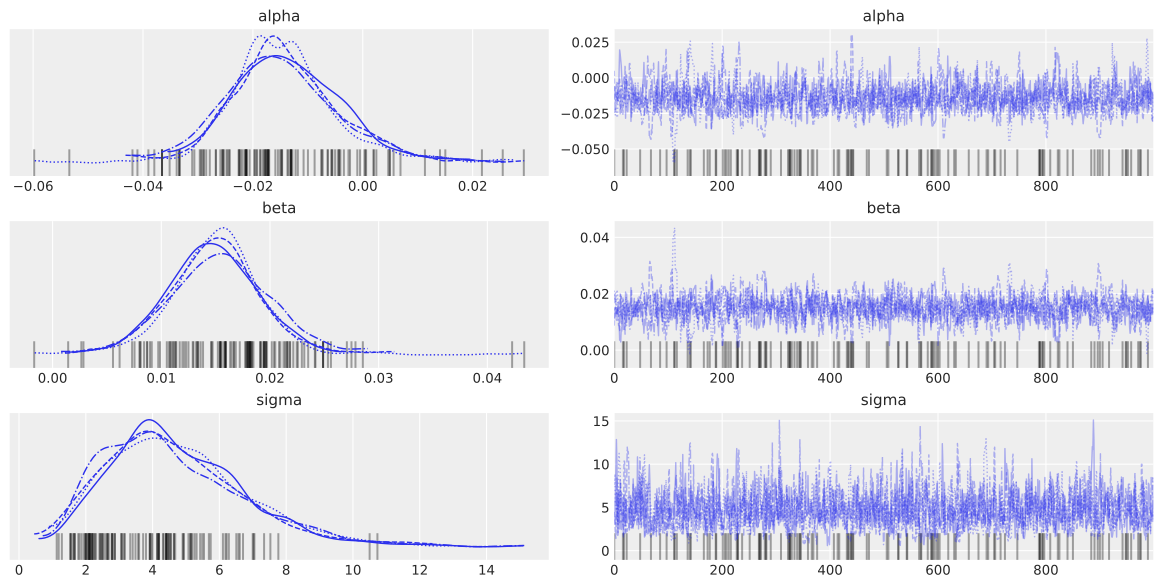
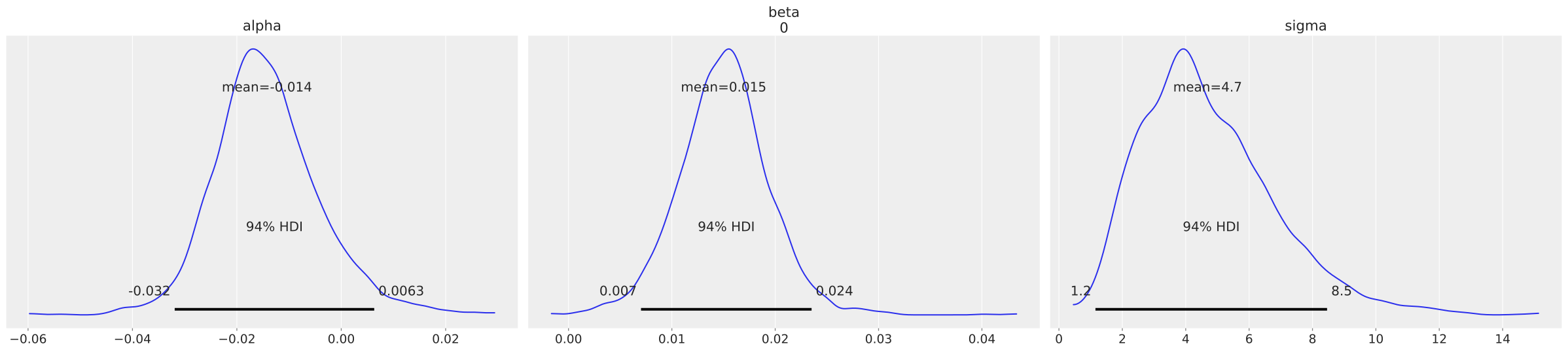
Additional information about the model and various visualizations can be revealed by Arviz, which seamlessly integrates with CmdStanPy components. Consider the following.
[11]:
import arviz as az
az.style.use("arviz-darkgrid")
[12]:
infdata = az.from_cmdstanpy(glm_gamma1.fitted_samples_)
infdata
[12]:
-
<xarray.Dataset> Dimensions: (chain: 4, draw: 1000, beta_dim_0: 1, mu_dim_0: 9, mu_unlinked_dim_0: 9) Coordinates: * chain (chain) int64 0 1 2 3 * draw (draw) int64 0 1 2 3 4 5 6 ... 994 995 996 997 998 999 * beta_dim_0 (beta_dim_0) int64 0 * mu_dim_0 (mu_dim_0) int64 0 1 2 3 4 5 6 7 8 * mu_unlinked_dim_0 (mu_unlinked_dim_0) int64 0 1 2 3 4 5 6 7 8 Data variables: alpha (chain, draw) float64 -0.01532 -0.006448 ... -0.009792 beta (chain, draw, beta_dim_0) float64 0.01482 ... 0.01252 sigma (chain, draw) float64 5.693 4.149 6.202 ... 3.381 8.383 mu (chain, draw, mu_dim_0) float64 0.008525 ... 0.04785 mu_unlinked (chain, draw, mu_unlinked_dim_0) float64 117.3 ... 20.9 Attributes: created_at: 2022-08-05T20:26:14.832783 arviz_version: 0.12.1 inference_library: cmdstanpy inference_library_version: 1.0.4 -
<xarray.Dataset>
Dimensions:          (chain: 4, draw: 1000)
Coordinates:
  * chain            (chain) int64 0 1 2 3
  * draw             (draw) int64 0 1 2 3 4 5 6 ... 993 994 995 996 997 998 999
Data variables:
    lp               (chain, draw) float64 -36.11 -36.88 ... -36.73 -37.15
    acceptance_rate  (chain, draw) float64 0.9991 0.9936 ... 0.9803 0.9989
    step_size        (chain, draw) float64 0.1811 0.1811 ... 0.2019 0.2019
    tree_depth       (chain, draw) int64 3 3 4 2 3 3 4 3 3 ... 3 4 4 4 3 2 3 3 4
    n_steps          (chain, draw) int64 15 11 15 5 7 7 15 ... 15 15 7 15 15 15
    diverging        (chain, draw) bool False False False ... False False False
    energy           (chain, draw) float64 36.58 37.17 38.51 ... 37.23 37.33
Attributes:
    created_at:                 2022-08-05T20:26:14.837437
    arviz_version:              0.12.1
    inference_library:          cmdstanpy
    inference_library_version:  1.0.4
[13]:
az.plot_posterior(infdata, var_names=['alpha', 'beta', 'sigma']);
[14]:
az.plot_trace(infdata, var_names=['alpha', 'beta', 'sigma'], compact=True);